RedFox Enterprise Security RedFox Enterprise Solutions
  • OUR SOLUTIONS
    PhishIQ Plus PhishIQ API PhishAgent Desktop Mobile Phishing Defender
  • RESOURCES
    Blog Knowledge Hub

Detection vs Prevention

Cybersecurity strategies are often described using two terms that sound similar but represent fundamentally different architectures: detection and prevention.

In the context of phishing protection, the difference is not semantic. It determines whether an organization blocks an attack before damage occurs or responds after exposure.

This section explains the architectural differences between reactive filtering systems and proactive prevention frameworks, and why prevention-first security models are replacing legacy detection-based approaches.
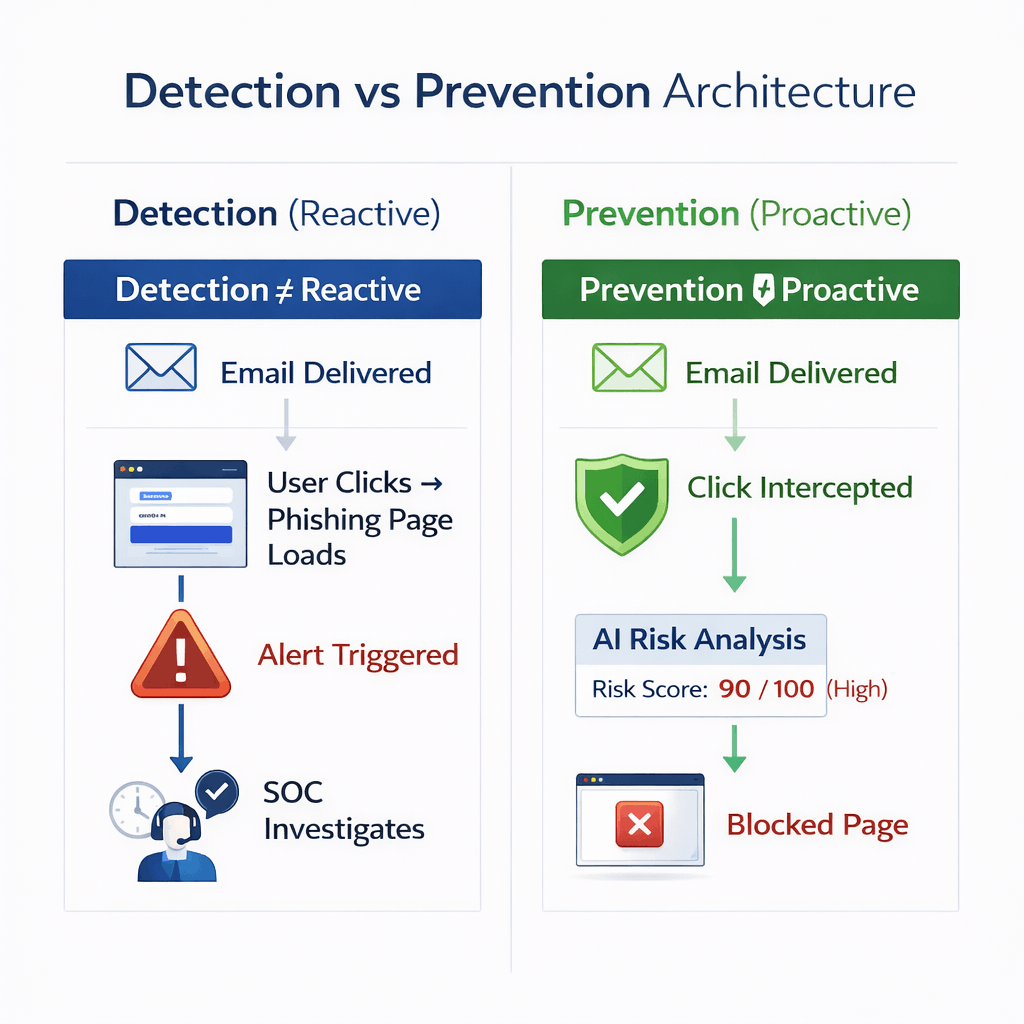

What Is Detection in Cybersecurity?

Detection-based security systems are designed to identify malicious activity after it appears in the environment. These systems rely on:

  • Signature-based filtering
  • Reputation databases
  • Blocklists and allowlists
  • Post-delivery scanning
  • Alerting and incident response workflows

In phishing protection, detection typically occurs:

  • After the email is delivered
  • After a user clicks a link
  • After a suspicious file is opened
  • After abnormal behavior is observed

This is known as reactive security architecture.

Key Characteristics of Detection Systems

  • Dependent on known threat intelligence
  • Effective against previously identified phishing domains
  • Limited visibility into zero-day phishing attacks
  • Often integrated into Secure Email Gateways and legacy web filters
  • Requires SOC intervention after alert generation

Detection reduces damage.
It does not eliminate exposure.

What Is Prevention in Cybersecurity?

Prevention-based security systems operate before execution. Instead of asking, "Is this domain known to be malicious?", prevention frameworks ask, "Does this object exhibit malicious characteristics?"

Prevention architecture includes:

  • Real-time URL analysis
  • Behavioral inspection before page rendering
  • AI-based risk scoring
  • Infrastructure fingerprinting
  • Pre-click decision engines

In phishing prevention, protection happens at the click level — before the browser loads the destination page.

This is proactive phishing defense.

Key Characteristics of Prevention Frameworks

  • Analyze unknown and zero-day phishing infrastructure
  • Operate independently of static blocklists
  • Use machine learning models for malicious link detection
  • Evaluate redirect chains and dynamic content
  • Deliver instant allow or block decisions

Prevention eliminates exposure.
It stops credential harvesting before it begins.

Architectural Comparison: Reactive Filtering vs Proactive Prevention

1. Threat Intelligence Dependency

Detection systems rely heavily on known indicators of compromise. If a phishing domain is not yet indexed, it may bypass filtering.

Prevention systems evaluate structural and behavioral signals in real time. Even newly registered domains can be flagged based on risk features such as:

  • Domain age anomalies
  • Hosting cluster patterns
  • Obfuscated URL structures
  • Redirect depth
  • Credential harvesting behavior

2. Timing of Control

Detection = after delivery
Prevention = before execution

This architectural timing difference is critical. Once a user interacts with a phishing page, the attack surface is already exposed.

Detection vs prevention architecture

3. Zero-Day Phishing Protection

Zero-day phishing attacks exploit the gap between domain registration and reputation indexing.

Detection struggles in this window.
Prevention engines are built specifically to close it.

Using machine learning feature extraction and behavioral analysis, prevention frameworks can classify malicious links without prior reputation history.

Why Modern Security Is Shifting Toward Prevention

The growth of phishing-as-a-service platforms and automated domain generation has reduced the lifespan of phishing infrastructure. Domains can be active for hours.

Reactive filtering systems cannot update blocklists fast enough.

Prevention frameworks use:

  • Real-time inspection
  • AI-driven link analysis
  • Instant decision engines
  • Click-level enforcement

This architectural shift aligns with Zero Trust security principles, where no URL is trusted by default.

Detection Still Has a Role

Detection remains important for:

  • Threat hunting
  • Forensics
  • Incident response
  • Post-breach analysis

However, relying solely on detection in phishing protection creates unavoidable exposure gaps.

A layered security strategy uses:

Prevention to block attacks
Detection to analyze what bypasses control layers

Conclusion: Prevention Is the Security Control Point

Detection asks whether a threat is already known.
Prevention evaluates whether it behaves like a threat.

In modern phishing defense, the decisive control point is before the click. Organizations that adopt proactive prevention frameworks reduce credential theft, account takeover, and lateral movement risk at the architectural level.

Detection improves visibility.
Prevention eliminates exposure.

That is the core architectural difference.

← Back to Knowledge Hub

Contact Info

+66-91-7100137

contact@ntrigo.com

Our Main Office

32, 6 Surasak Road, Bangrak,
Bangkok 10500 Thailand

Get in Touch

Ready to protect your organization?

Contact Us Now

(c) RedFox Enterprise Solutions by NTrigo | Privacy Policy | Terms of Use | Trust & Security

LinkedIn Facebook