RedFox Enterprise Security RedFox Enterprise Solutions
  • OUR SOLUTIONS
    PhishIQ Plus PhishIQ API PhishAgent Desktop Mobile Phishing Defender
  • RESOURCES
    Blog Knowledge Hub

Enterprise Phishing Defense Architecture

Designing Scalable Phishing Protection Across Endpoints, Mobile, SaaS and Customer Applications

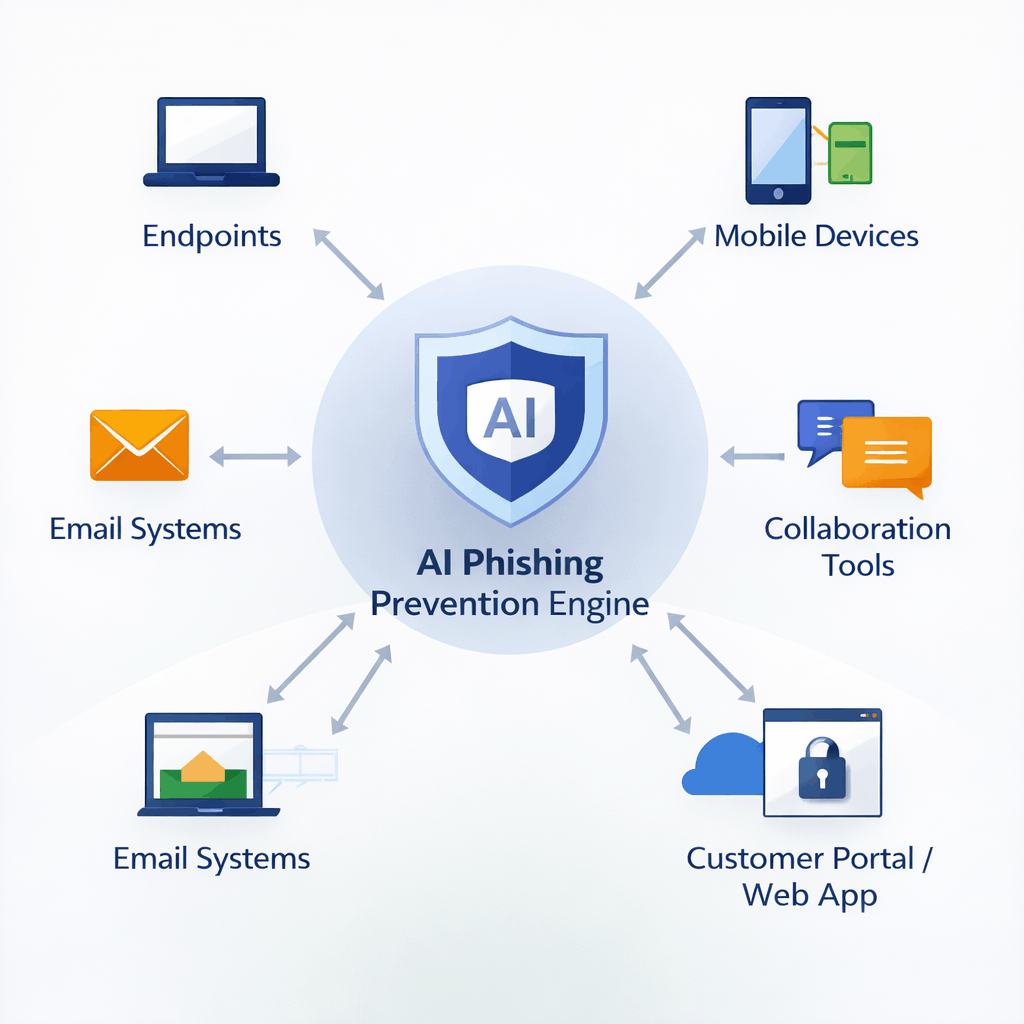
Phishing attacks no longer target only corporate email. Modern campaigns exploit endpoints, mobile devices, SaaS applications, collaboration tools, and even customer-facing portals. Enterprise phishing defense architecture must therefore be distributed, scalable, and prevention-driven.

This section outlines how to design a scalable enterprise phishing protection framework that operates across the entire digital attack surface.

Why Traditional Email Security Is No Longer Enough

Legacy Secure Email Gateways were built for inbound email filtering. Today's threat landscape includes:

  • Direct-to-browser phishing links
  • Smishing on mobile devices
  • OAuth abuse in SaaS platforms
  • Collaboration app phishing
  • Account takeover targeting customer portals

An enterprise phishing defense architecture must protect:

  • Employees
  • Remote workers
  • Mobile users
  • SaaS environments
  • Customers

Security cannot depend on a single control layer.

Core Layers of Enterprise Phishing Defense

1. Endpoint-Level Protection

Endpoints remain a primary phishing execution surface.

Enterprise architecture should include:

  • Real-time URL inspection before browser rendering
  • Click-level phishing prevention
  • AI-based malicious link detection
  • Browser isolation or secure web gateway integration

Protection must function even if the phishing link bypasses email filtering.

2. Mobile Phishing Protection

Mobile phishing, including SMS-based attacks, often bypasses corporate gateways.

Scalable mobile phishing defense requires:

  • On-device URL analysis
  • Lightweight risk scoring engines
  • DNS-layer inspection
  • App-to-browser redirect monitoring

Mobile endpoints cannot rely solely on network-based controls.

3. SaaS and Collaboration Security

Phishing increasingly targets cloud-based SaaS platforms such as identity providers and productivity suites.

Enterprise architecture must integrate with:

  • Identity systems
  • API-level monitoring
  • OAuth authorization flows
  • Conditional access policies

Detection of suspicious login flows and token abuse must occur in real time.

4. Customer-Facing Application Protection

Attackers frequently clone brand portals to harvest customer credentials.

Enterprise phishing prevention must extend to:

  • Brand impersonation monitoring
  • Domain similarity analysis
  • Infrastructure clustering detection
  • Real-time takedown workflows

This layer protects revenue, reputation, and customer trust.

Centralized AI Risk Engine

At the core of enterprise phishing defense architecture is a centralized risk scoring engine.

This engine performs:

  • Feature extraction from URLs and infrastructure
  • Behavioral analysis of landing pages
  • Redirect chain tracing
  • Machine learning classification
  • Zero-day phishing detection

Instead of relying on static blocklists, the architecture evaluates each object dynamically.

The decision model should deliver:

  • Allow
  • Challenge
  • Block

Within milliseconds.

Enterprise phishing defense architecture

Architectural Principles for Scalability

Distributed Enforcement Points

Protection must operate across:

  • Browsers
  • Secure web gateways
  • Endpoint agents
  • Mobile security clients
  • API integrations

A centralized engine with distributed enforcement ensures consistent policy.

Cloud-Native Infrastructure

Scalable phishing protection requires:

  • Elastic processing
  • Global threat intelligence sharing
  • High-availability architecture
  • Low-latency inspection

Cloud-native design enables rapid response to emerging phishing infrastructure.

Zero Trust Alignment

Enterprise phishing defense should align with Zero Trust security principles:

  • No implicit trust in URLs
  • Continuous verification
  • Context-aware access decisions
  • Identity and device validation

Phishing prevention becomes part of identity security architecture.

Detection and Prevention in Enterprise Context

Detection remains critical for:

  • Threat hunting
  • SOC analytics
  • Incident response
  • Forensic investigation

However, enterprise-scale protection depends on prevention at the point of interaction.

Stopping phishing before credential submission eliminates downstream impact such as:

  • Account takeover
  • Lateral movement
  • Privilege escalation
  • Data exfiltration

Conclusion: Designing for the Entire Attack Surface

Enterprise phishing defense architecture must move beyond email filtering toward a distributed, AI-driven prevention framework.

Protection should:

  • Operate before execution
  • Scale across endpoints and mobile
  • Integrate with SaaS ecosystems
  • Extend to customer-facing environments

In modern cybersecurity architecture, phishing protection is not a feature.
It is a foundational control layer across the enterprise attack surface.

← Back to Knowledge Hub

Contact Info

+66-91-7100137

contact@ntrigo.com

Our Main Office

32, 6 Surasak Road, Bangrak,
Bangkok 10500 Thailand

Get in Touch

Ready to protect your organization?

Contact Us Now

(c) RedFox Enterprise Solutions by NTrigo | Privacy Policy | Terms of Use | Trust & Security

LinkedIn Facebook