RedFox Enterprise Security RedFox Enterprise Solutions
  • OUR SOLUTIONS
    PhishIQ Plus PhishIQ API PhishAgent Desktop Mobile Phishing Defender
  • RESOURCES
    Blog Knowledge Hub

MFA Alone Is Not Enough: Why Organizations Still Fall Victim to Phishing

Multi-Factor Authentication remains essential — but modern phishing attacks bypass it through session hijacking, impersonation, and attacks that start long before login.

For years, Multi-Factor Authentication (MFA) has been considered one of the most effective ways to protect corporate accounts. Many organizations invested heavily in MFA under the assumption that adding an extra verification step beyond a password would significantly reduce the risk of account compromise.

While MFA remains an essential security control, phishing attacks continue to succeed. Even organizations with MFA in place still face account takeovers, data breaches, and unauthorized access.

Why MFA Matters

MFA adds an additional layer of security beyond a password. Even if a password is stolen or exposed, attackers must still pass another verification step, such as a one-time code, an authenticator app, or a security key.

This remains a critical defense mechanism and greatly reduces the risks associated with weak, reused, or compromised passwords.

How Attackers Bypass MFA

Modern phishing attacks are no longer focused solely on stealing passwords.

One increasingly common technique is the Adversary-in-the-Middle (AiTM) attack. In this scenario, victims are directed to a phishing site that closely mimics a legitimate login page. When users enter their credentials and complete the MFA process, the attacker relays the information to the legitimate service in real time.

In many cases, the attacker does not need the password or MFA code afterward. Instead, they steal the active session token or authentication cookie, allowing them to access the account as if they were the legitimate user.

Adversary-in-the-Middle phishing attack flow

The Problem Starts Before Authentication

Many organizations focus heavily on securing the login process but overlook what happens before it.

When an employee clicks a malicious link, scans a fraudulent QR code, or visits a spoofed website, the attack may already be underway long before MFA comes into play.

Once a user reaches a phishing page, the attacker has already gained a significant advantage.

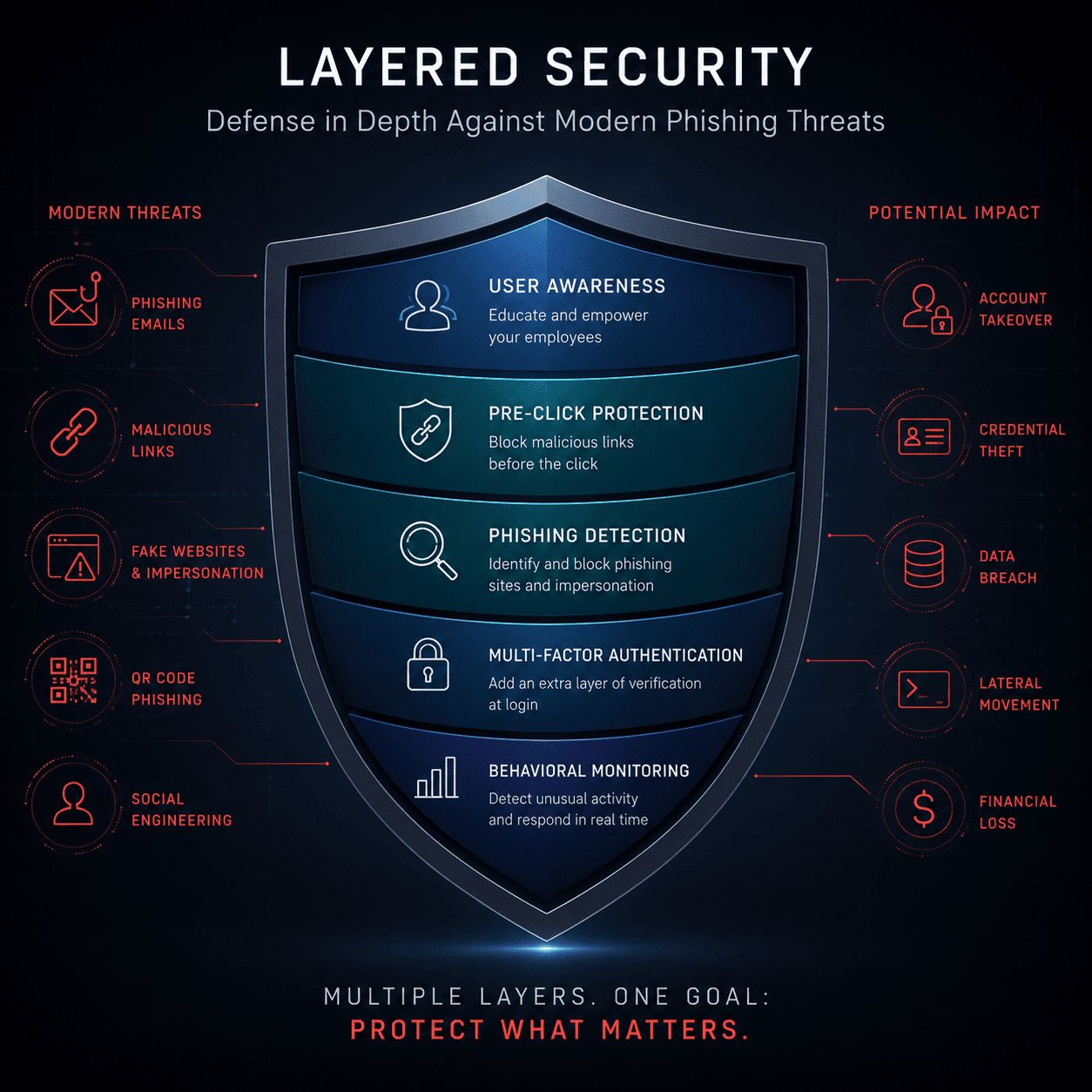
Why a Layered Security Approach Is Essential

Today's cyber threats require more than a single security control.

An effective security strategy should include:

  • Multi-Factor Authentication (MFA)
  • Real-time malicious link detection and blocking
  • Protection against phishing websites and impersonation attacks
  • Monitoring for suspicious account activity
  • Security awareness training
  • Rapid response capabilities for emerging threats

When one layer fails, additional layers continue to protect the organization.

Security Before the Click

One of the most effective ways to reduce phishing risk is to stop the threat before the user reaches the malicious website.

Pre-click security solutions identify suspicious links in real time and prevent users from visiting phishing pages in the first place. This approach complements MFA and helps defend against the advanced phishing techniques used by today's attackers.

Conclusion

MFA remains a vital component of any modern cybersecurity strategy, but it is no longer sufficient on its own. Advanced phishing attacks can bypass authentication controls through session hijacking, impersonation, and other sophisticated techniques.

Organizations that want to stay ahead of modern threats should adopt a layered security approach that includes phishing prevention, real-time threat detection, and protection that starts before the click.

← Back to Knowledge Hub

Contact Info

+66-91-7100137

contact@ntrigo.com

Our Main Office

32, 6 Surasak Road, Bangrak,
Bangkok 10500 Thailand

Get in Touch

Ready to protect your organization?

Contact Us Now

(c) RedFox Enterprise Solutions by NTrigo | Privacy Policy | Terms of Use | Trust & Security

LinkedIn Facebook